Service Businesses Mostly accurate, with one big caveat
Vending machine “passive income”: what one honest car-wash video reveals
Verdict: Mostly accurate, with one big caveat. The creator is refreshingly truthful about how little a vending machine earns — but the cash he collects only exists because of a quarter-million-dollar car wash doing the heavy lifting.
In “Collecting Cash From My Vending Machine for the First Time!”, a creator who goes by StephentheInvestor walks his car-wash lot, empties eight coin-op vacuums and one secondhand vending machine, and counts the take on camera. The video has pulled in 62,357 views. The headline number? Sixty-one dollars in cash from the vending machine for the whole month — and the creator says so plainly, without spin. That honesty is the story here, because it’s the exact opposite of the genre it gets recommended alongside.
What the video actually claims
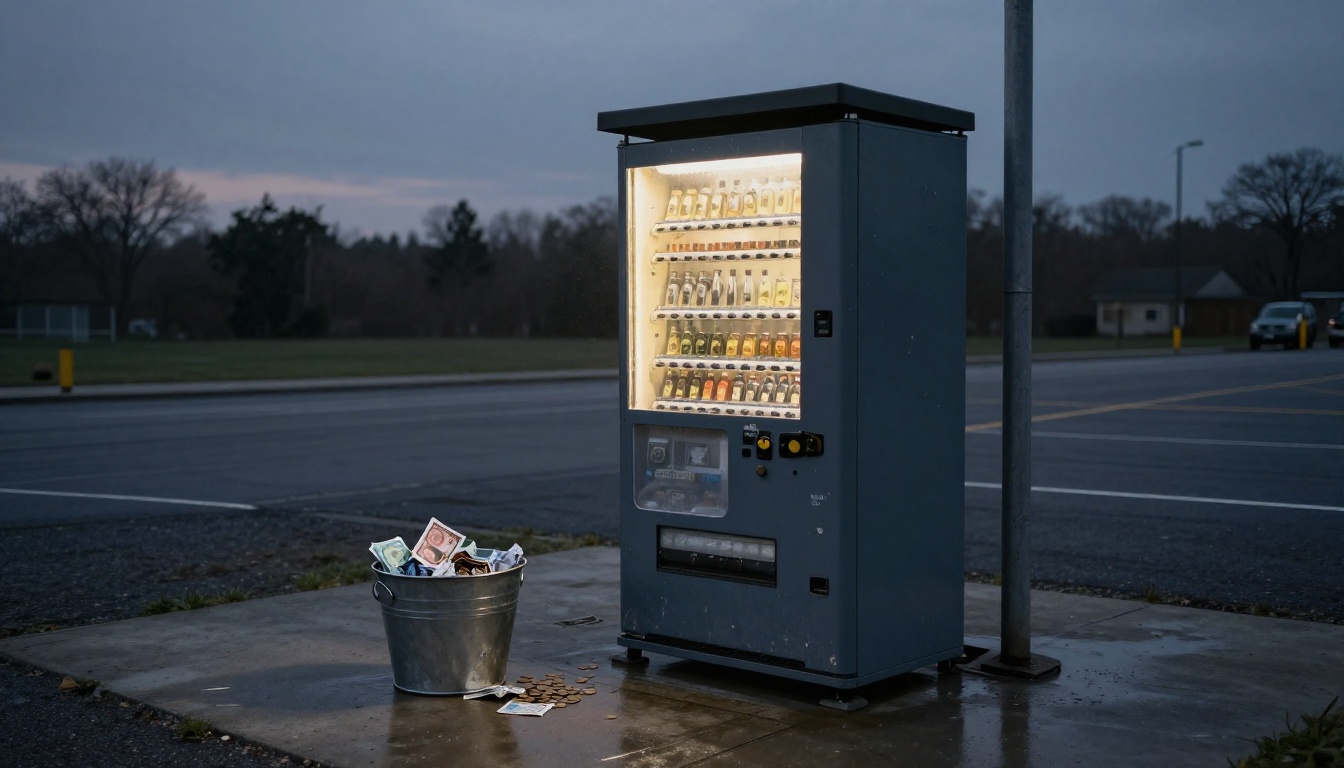
There’s no pitch deck and no course link. The creator collects cash, separates coins from tokens, and tallies it out loud while admitting he’s bad at math. The vending machine — a “high security” unit he got free with an old automatic wash bay, which he says runs about $8,500 new — produced roughly $61 in bills and $21.50 in quarters, plus a little credit-card volume, for about $129.50 in vending sales that period. The eight vacuums brought in $590.50. Total cash in the bucket: around $720.
He’s candid about margins. The Little Trees-style air fresheners cost him 60 cents and sell for $1.25. “I don’t suspect I’d get rich one way or the other,” he says about raising the price to two bucks. On vending generally: “you don’t really make a lot of money off of these… they are for customer convenience, more so than anything.”
Then comes the line that reframes everything. His car wash, he notes, “averages around 20 to $25,000 a month,” and halfway through this rainy month he’s only at about $7,000 and “way behind.” The video also carries a paid read for Homebase, a scheduling and payroll app, pitched as saving owners “up to 20 hours a month.” So this isn’t a passive-income story at all. It’s a working operator documenting a slow month.
What the method actually requires
Here’s where the broader YouTube genre and this particular video part ways. Search “vending machine passive income” and you’ll find dozens of videos selling the machines themselves as the business — buy a few, place them, collect cash, retire. The numbers don’t cooperate.
Independent industry data puts a typical U.S. vending machine at $150–$400 in monthly gross revenue, with net margins around 25–35% — roughly $40–$120 a month per machine after product, location commission, and maintenance, according to operator analyses compiled by VendSoft. High-traffic specialty placements can do far better, but those are the exception, not the median. At $61 of cash for the month, this creator’s machine is sitting near the bottom of that range — and he knows it, which is why he’s already talking about swapping out products that “hasn’t even been touched.”
Now layer in what makes those coins appear at all. A self-serve car wash with a few bays and vacuum stations runs roughly $250,000 to start on the low end, per cost breakdowns gathered by Starter Story and similar industry sources — land, drainage, pressure equipment, coin and token systems, the works. The vacuums that earned $590.50 aren’t free money; they’re amortizing equipment, water, electricity, replaced hoses, and the token-handling headache the creator spends half the video untangling.
| Item in the video | What it earned / cost |
|---|---|
| Vending machine (month 1 cash) | ~$61 |
| Vending total incl. credit | ~$129.50 |
| Eight vacuums (this collection) | $590.50 |
| Air freshener margin | $1.25 sell − $0.60 cost = $0.65 |
| Vending machine if bought new | ~$8,500 |
| The car wash behind it all | ~$20,000–$25,000/month |
The token mess deserves a mention because it’s the unspoken labor nobody films. He buys high-security tokens at 50–52 cents each to stop people using “Chuck-E-Cheese type” coins, then dispenses cheap 15-cent tokens with automatic washes — and ends up hand-sorting nearly identical coins by hand because his counting machine can’t tell them apart. That’s the “passive” part: an hour of sorting metal for a few hundred dollars.
Is vending really passive income?
No. Not at the scale these videos imply, and not in year one of anything.
The U.S. Small Business Administration is blunt about why people misjudge this: it urges new owners to map both one-time costs (equipment, permits) and a full year of monthly expenses — ideally five years — before assuming profit. Restocking, cash handling, repairs, theft, and location fees are ongoing. A machine is a small retail operation with no employee, which means you are the employee. The creator in this video is living that reality, not selling around it.
And the survival odds aren’t kind to the underlying businesses. Bureau of Labor Statistics data shows only 34.7% of establishments born in 2013 were still operating a decade later — about half don’t make it past five years. Vending routes and car washes aren’t exempt from that math.
Who actually wins this game
Vending makes real money for two kinds of operators, and neither matches the dream in the thumbnail. The first is route operators at scale — people running 30, 50, 100 machines, where $80 a month times a large fleet plus efficient restocking logistics adds up to a genuine income, and where the work is a full-time job in a van. The second is operators who already own the foot traffic, like this car-wash owner, where the machine is a small add-on to a business that draws customers for another reason entirely. He even floats adding a soda machine up front “because there is some amount of foot traffic that would probably stop and get a can of soda.” That only works because cars already come to wash.
The people who lose are the ones sold the machines as a standalone passive engine. The FTC has been busy here: in August 2025 the agency permanently banned the operators of a business-opportunity scheme that promised guaranteed “passive income” from online stores that rarely materialized. The same playbook — “buy this, place it, collect cash” — recurs across vending, e-commerce, and rental “opportunity” pitches. (For the record, this creator is selling nothing of the kind. He’s just counting his own quarters.)
What you’d realistically earn
If you placed one vending machine in a decent spot tomorrow, plan on $40–$120 a month in profit, possibly less while you learn which products move and which sit. To clear a meaningful side income — say $1,500 a month — you’d need somewhere around 15–30 well-placed machines and the route labor to service them, which is a part-time-to-full-time job, not mailbox money.
Compare that to the video. The vending machine earned $61. The vacuums earned $590.50. The car wash they’re attached to does $20,000–$25,000 in a good month and was running at half pace this one. The “passive” vending and vacuum cash is a rounding error on a capital-intensive, weather-dependent, hands-on business. That’s not a knock on the creator — it’s the actual shape of the opportunity, and he shows it more honestly than most.
If you want the broader pattern, we’ve checked the machines-as-income genre before in 9 machines making people rich in 2026 (the reality check) and run the numbers on a basket of these schemes in I tried 12 passive income ideas to make $100,000 in 2026.
Who this is (and isn’t) for
A vending machine makes sense if you already control a location with steady traffic — a wash, a gym, an office, a laundromat — and you treat the machine as a convenience that nudges a few extra dollars per customer. It also works if you’re willing to build and service a real route as a job, with a vehicle, restocking time, and tolerance for repairs and the occasional jammed bill validator. It does not make sense if you saw a video promising hands-off income, have no existing foot traffic, and expect a machine or two to replace a paycheck. The capital and the labor are real; the “passive” framing is the part that isn’t.
What to remember
This video is the rare one that tells the truth by accident: a man counting $61 from a vending machine, surrounded by the quarter-million-dollar business that actually pays his bills. Believe his numbers. Just don’t believe the videos that show the cash bucket without the wash behind it.
Sources
- FTC. “FTC Case Against E-Commerce Business Opportunity Scheme and its Operators Results in Permanent Ban from Industry.” 2025. https://www.ftc.gov/news-events/news/press-releases/2025/08/ftc-case-against-e-commerce-business-opportunity-scheme-its-operators-results-permanent-ban-industry
- U.S. Bureau of Labor Statistics. “34.7 percent of business establishments born in 2013 were still operating in 2023.” 2024. https://www.bls.gov/opub/ted/2024/34-7-percent-of-business-establishments-born-in-2013-were-still-operating-in-2023.htm
- U.S. Small Business Administration. “Calculate your startup costs.” 2025. https://www.sba.gov/business-guide/plan-your-business/calculate-your-startup-costs
- VendSoft. “Vending Machine Profit: Real Numbers.” 2026. https://www.vendsoft.com/vending-machine-profit/
- Starter Story. “How Profitable Is a Self-Serve Car Wash?” 2025. https://www.starterstory.com/ideas/self-service-car-wash/profitability
- Video: Collecting Cash From My Vending Machine for the First Time!
- Channel: StephentheInvestor
- Views at review: 62,357
- Watch on YouTube: https://youtube.com/watch?v=yKD_tJJubP8
Views and figures were accurate at the time of review and may have changed since publication.