AI Side Hustles Hype — the math doesn't survive a calculator
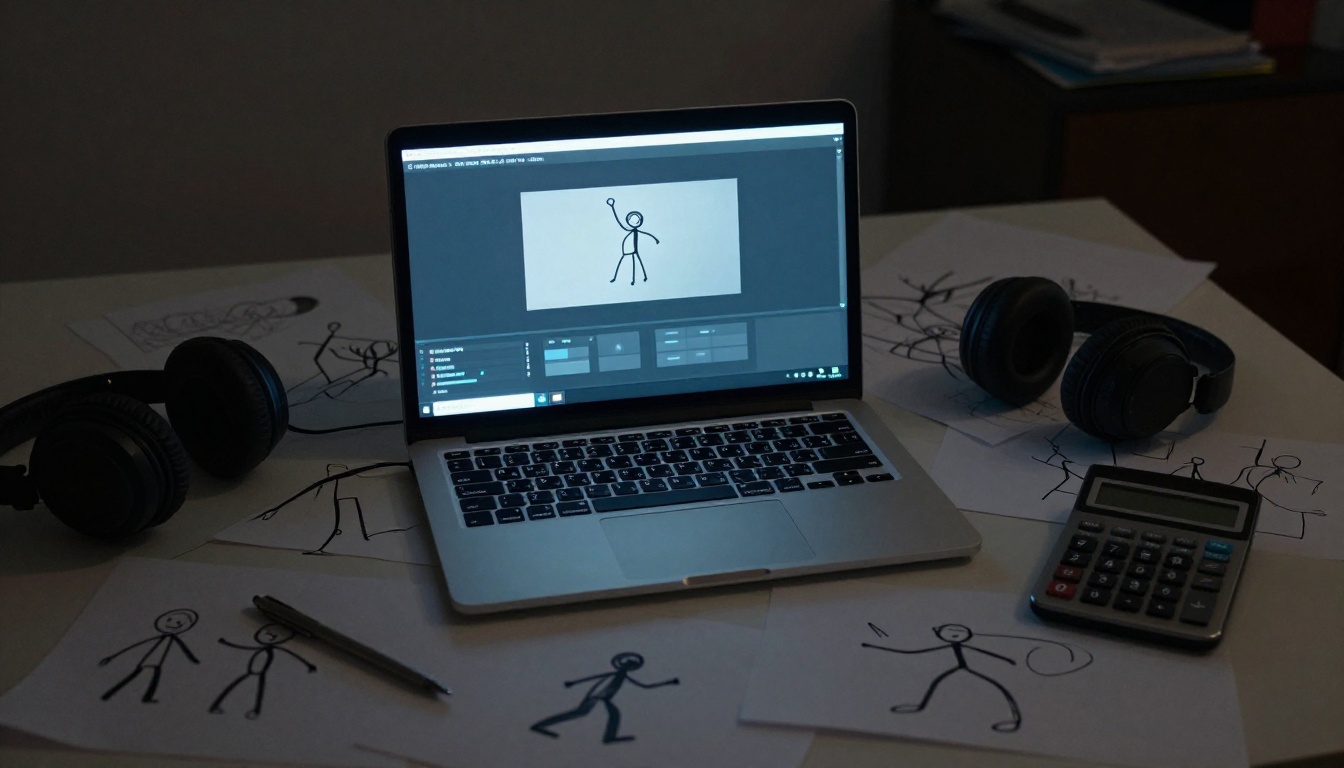
Claude + YouTube for $77,000/month: the demonetization math the stick-figure pitch skips
Verdict: Hype — the math doesn’t survive a calculator. The free workflow really does produce videos; the $77,000 number is attached to nothing the video can prove.
A channel called zapiwala ai posted a video titled “Claude Code (Free Plan) + YouTube = $77,000/Month.” It had nearly 119,000 views when we looked. The pitch: paste one prompt into the free version of Claude, generate a stick-figure “doodle” video end to end with free tools, upload it, and watch the money arrive. Here’s the short answer. You can build the video for almost nothing. You almost certainly cannot build the income.
What the video actually claims
The hook is a real-looking case study. A “stick man” channel — still images of hand-drawn figures, no animation, AI voice-over — supposedly pulled 7.5 million views on a single video and 14.5 million total across 14 videos in two months. The creator’s argument is that if a channel that crude can do those numbers, you can copy the system.
Then comes the workflow, and to be fair, it’s specific. One master prompt (in the pinned comment) turns Claude’s free plan into a script writer that spits out five “viral” topics and a full 5-to-15-minute script. You generate a voice-over on ElevenLabs’ free plan using a voice called “Raunak.” You run the audio through a transcription tool to find the exact pauses, feed those timestamps back to Claude to write an image prompt for every line, then bulk-generate 100-plus images in Google Flow using the “Nano Banana 2” model — automated by a Chrome extension the creator built (zappywala.ai). Assemble in any editor, sync images to the voice-over pauses, ask Claude for “viral” metadata and thumbnails, publish.
Notice what’s missing. The number in the title — $77,000 a month — never appears in the video. There’s no revenue screenshot, no AdSense dashboard, no payout statement. The only “proof” offered is someone else’s view count. The income figure is the headline, and it’s the one thing the creator never substantiates.
What the method actually requires
Let’s start with the part the title quietly depends on: monetization eligibility. To earn ad revenue at all, a channel needs to be accepted into the YouTube Partner Program — 1,000 subscribers plus 4,000 valid public watch hours in the past 12 months, or 10 million Shorts views in 90 days, with a linked AdSense account and two-step verification, per NerdWallet’s monetization breakdown. That’s the floor, not the finish line.
Now the harder wall. In July 2025, YouTube tightened its rules on what it calls “inauthentic content.” The platform’s own channel monetization policy page defines it as “mass-produced or repetitive content,” including content “that looks like it’s made with a template with little to no variation across videos, or content that’s easily replicable at scale.” The penalty clause is the part to read twice: “This policy applies to your channel as a whole… if you have videos that violate our guidelines, monetization may be removed from your entire channel.”
Read the workflow against that sentence. One prompt, one repeatable image style, AI narration, “easily replicable at scale” — by 103-image batches, automated by a browser extension. That is close to a description of exactly what YouTube says it will demonetize.
There’s a second catch hiding in the free-tools promise. ElevenLabs’ pricing page confirms the free plan gives you 10,000 credits a month (roughly 10 minutes of speech) — but it does not include a commercial license. Commercial use starts on the paid Starter plan. A monetized YouTube video is commercial use. The video’s own fix for the credit ceiling — “create another free account and keep going” — is a terms-of-service violation stacked on top of a licensing one.
| What the video calls free | The actual constraint |
|---|---|
| Claude free plan for scripts | Fine for drafting; daily message limits throttle volume |
| ElevenLabs free plan voice | 10 min/month, no commercial license for monetized video |
| Transcription tool credits | 10 min free, then “make a new account” (against ToS) |
| Google Flow image generation | Subject to its own usage limits and terms |
| Monetization | Gated by YPP thresholds and the inauthentic-content rule |
So where does $77,000 a month actually come from?
Nowhere the video can show you. But run the calculator anyway. RPM — what a creator actually keeps per 1,000 views after YouTube takes its 45% cut — sits at a conservative $1 to $5 for most channels, again per NerdWallet. Animation and general-entertainment faceless content tends to land at the low end, roughly $2 to $4.
Take the generous end. At a $5 RPM, $77,000 a month requires about 15.4 million monetized views every single month — not once, every month. At a $2 RPM, which is closer to what stick-figure entertainment earns, you’d need around 38 million monetized views a month. The viral channel the video dangles as proof did about 7.25 million views a month at its peak. At $2 RPM that’s roughly $14,500 a month gross — assuming it stays monetized, which, given the July 2025 policy, is the assumption doing all the work.
Could a channel like this make money? Yes — some do. Could it reliably make $77,000 a month? That would put it in a tier of consistency that even established media operations struggle to hold.
Who actually wins this game
The people who win with faceless AI video aren’t the ones running the exact free workflow in the video. They’re operators who treat it as a content factory with a real budget: paid voice licenses, multiple channels to spread risk, A/B-tested thumbnails, and enough volume that one viral hit pays for fifty flops. Early movers helped too — channels that built subscriber bases and search rank before the niche flooded and before YouTube renamed “repetitious content” to “inauthentic content” and started enforcing it.
The person the video is actually aimed at — no audience, no budget, copying one template — is the person the 2025 policy was written to filter out. That’s the uncomfortable overlap.
What you’d realistically earn
For a brand-new channel running this exact method, the honest range for the first six months is close to $0, because you won’t clear the 1,000-subscriber and 4,000-hour bar quickly with templated content the algorithm and the policy both deprioritize. If a video does break out and the channel survives review, a few thousand subscribers and a couple million views over a year might translate to a few hundred to a couple thousand dollars a month — before you subtract a paid voice plan you legally need once you monetize. Set that against $77,000 a month and the gap isn’t a rounding error. It’s the entire claim.
Who this is (and isn’t) for
This makes sense as a cheap way to learn AI video production — scripting, pacing, editing rhythm — if you have a few hours a week, treat the income as a maybe, and plan to develop a real style instead of running one template forever. It does not make sense if you’re counting on it to replace a paycheck, if you can’t budget the modest paid plans that commercial use requires, or if you’re not prepared for the live risk that YouTube demonetizes the whole channel under a policy aimed squarely at content “easily replicable at scale.”
A note on the headline number
Big, round, unsupported income figures in titles aren’t just optimistic marketing. In the U.S., the FTC has proposed rules that would require sellers of money-making opportunities to hold written substantiation for any earnings claim and hand it over on request. The agency has already settled cases over deceptive earnings claims. A YouTube creator pinning a comment isn’t the target of that rulemaking the way a course seller is — but the principle is a useful reader’s filter: if a number can’t be substantiated, treat it as a thumbnail, not a forecast.
What to remember
The workflow is genuinely clever, and the tools genuinely cut production cost toward zero. That’s the half that’s true. The other half — that cheap production equals $77,000 a month — runs straight into RPM math, YouTube’s inauthentic-content rule, and a free voice plan that isn’t licensed for the very thing you’d use it for. If you want to learn the craft, the prompt costs you nothing. If you want the income in the title, the calculator doesn’t agree. For more in this genre, see our look at the Claude Code $62,000/month YouTube pitch and how to beat the new YouTube algorithm for faceless channels.
Sources
- YouTube Help. “YouTube channel monetization policies (inauthentic content).” 2025. https://support.google.com/youtube/answer/1311392?hl=en
- NerdWallet. “How to Make Money on YouTube in 2026: 5 Ways to Monetize.” 2026. https://www.nerdwallet.com/article/finance/how-to-make-money-with-youtube
- FTC. “FTC Proposes Rule Changes and New Rule to Deter Deceptive Earnings Claims by Multilevel Marketers and Money-Making Opportunity Sellers.” 2025. https://www.ftc.gov/news-events/news/press-releases/2025/01/ftc-proposes-rule-changes-new-rule-deter-deceptive-earnings-claims-multilevel-marketers-money-making
- ElevenLabs. “Pricing.” 2026. https://elevenlabs.io/pricing
- Video: Claude Code (Free Plan) + YouTube = $77,000/Month
- Channel: zapiwala ai
- Views at review: 118,951
- Watch on YouTube: https://youtube.com/watch?v=WVT2FCjhDDY
- View counts and channel numbers may have changed since this review was published.