E-commerce & Dropshipping Half-true — works only if you do the unspoken work
$1 to $1,000 in 7 days on Facebook Marketplace: the flip math the video skips
Verdict: Half-true — works only if you do the unspoken work. The flips and the print-on-demand store are real, but the engine runs on a truck, a past audience, and 2,700 prior orders the video never puts on the scoreboard.
MoMike Chamberlin’s video “$1 to $1,000 in 7 Days (Facebook Marketplace)” has pulled in roughly 245,000 views on a simple promise: start with a single dollar and stack it into a grand through “various real-life and online money-making schemes.” He’s upfront that he fell short — the seven-day total lands at $866.38. So is the method real, or is the shortfall the tell? Both, actually. The hustles work; the starting line doesn’t.
What the video actually claims
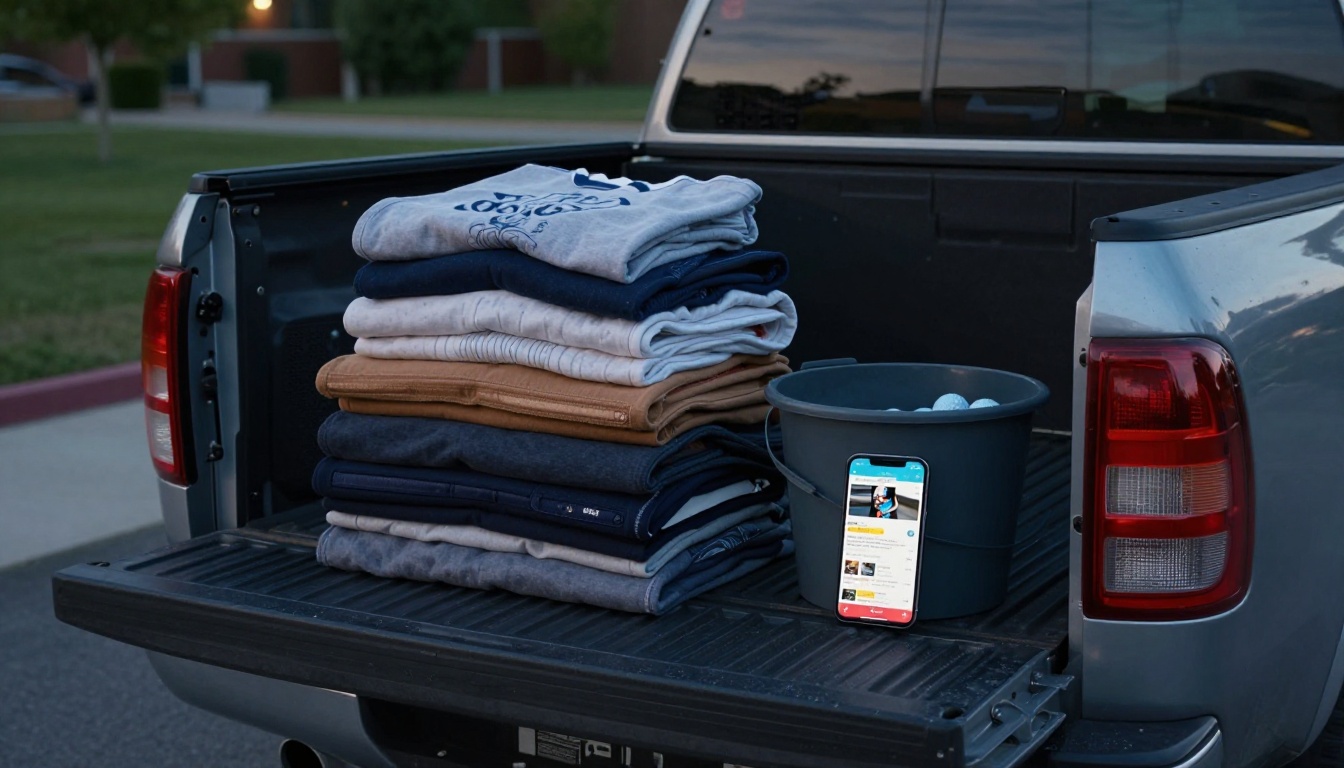
The challenge runs in stages. First comes free flipping: the creator trawls the free sections of Facebook Marketplace, OfferUp, Craigslist, and the Buy Nothing app, hauling away two commercial coffee machines, a broken $1,200 fridge, a punching bag, a gaming chair, and a pair of couches. He uses ChatGPT to price the coffee machines and to write platform-specific listing copy. Then he adds golf-ball reselling (129 balls fished out of a course canyon, bundled for $20 to $75) and Depop thrift flipping (about $37 of secondhand clothes relisted at $25–$50 each).
The finale is print-on-demand. The creator designs meme t-shirts with AI, lists them through a sponsor called Tap Stitch, and drives sales with paid Meta ads — $50 a day scaling to $150 a day across three campaigns. He’s candid that this part is sponsored, and he drops an affiliate code and a free PDF setup guide in the description.
His headline proof point: “over the last 4 months of me testing it on my own store, I’ve generated over $130,000 in sales,” built on more than 2,700 orders. That’s the number doing the persuading. The $866 he actually earns in seven days is almost a footnote to it.
What the method actually requires
Start with the flips, because they’re the most honest part. Secondhand reselling is a genuine side hustle — NerdWallet lists it among its top side-business ideas and is blunt that “to make real money, you need to dedicate time and effort,” using the example of someone who bought a guitar on Facebook Marketplace, restrung it, and resold it for a $50 profit (NerdWallet, 2025). That’s the real rhythm: small spreads, lots of handling. The creator’s own results bear it out — $40 for the punching bag, $40 for the chair, $100 for the couches, $150 for a coffee machine, $40 for a fridge nobody could fix. Good flips. Also a full day of driving, loading, cleaning, photographing, listing, and messaging buyers, for maybe $300 gross before gas.
The golf balls and Depop are the same story at smaller scale. Depop no longer charges U.S. and U.K. sellers a selling fee, but it still takes 3.3% plus $0.45 per order in payment processing, and the buyer pays a marketplace fee of up to 5% plus $1 at checkout — so a $28 windbreaker nets less than the sticker. On $37 of thrifted clothes the creator reports an $18 profit on one shirt.
Real money, but this is grocery money, not a grand.
The print-on-demand numbers are where the “7 days” framing strains. POD margins are thinner than the glossy version suggests. Shopify’s own guidance tells sellers to “aim for a 40 to 60 percent net margin per order after every fee, including platform fees, payment processing, ads, and a refund reserve” — and most sellers who hit that have organic traffic, not paid (Shopify, 2026). Once you buy your traffic, the math compresses fast. Watch it happen in the video’s own ledger:
| Day | Ad spend | Product cost | Revenue | Profit |
|---|---|---|---|---|
| 5 | $55.93 | $42.11 | $105.00 | $6.96 |
| 6 | $119.54 | $126.54 | $349.90 | $103.82 |
| 7 | — | — | — | $354.93 |
Day five is the honest snapshot: $105 in sales, $6.96 kept. A single refund or one dead campaign flips that red. Industry ad benchmarks put the cost to acquire an apparel customer on Meta somewhere around $20–$40 — on a $25–$30 shirt, that eats the margin whole unless your creative and targeting are already sharp. His were. That’s not an accident.
Who actually wins this game?
The person who wins this challenge is the person who already did it once. By his own account, the creator brings a truck, a house to store inventory, a year of golf-ball reselling behind him, “a few hundred thousand followers on TikTok” he used to promote that business, and — crucially — 2,700+ prior print-on-demand orders and $130,000 in sales on the exact platform he’s now “testing.” He even says the sponsor reached out because he was already a heavy customer.
None of that is hidden, to his credit. But none of it is subtracted from the “$1” either. A true beginner starting from one dollar has no vehicle to move a fridge, no audience to lean on, and no feel for which Meta ad will convert and which will quietly burn $56 for a single sale. The free coffee machines were real. So was the skill that turned them into cash — and that skill took years, not days.
What you’d realistically earn
Flip reselling at the pace the video shows — part-time, nights and weekends, a few dozen listings — tends to land most beginners in the low hundreds a month, not four figures in a week. That tracks with the hands-on reality NerdWallet describes and with the small, real spreads in the video itself. You might clear $200–$800 a month once you’ve got a sourcing routine and a feel for what sells locally. The seven-day sprint compresses months of that into a highlight reel.
Print-on-demand with paid ads is the higher-ceiling, higher-risk lane, and it’s brutal for newcomers. One widely cited market study pegs the three-year survival rate for POD stores at roughly 24% — about three in four are gone inside three years. A first-timer running Meta ads against meme shirts should plan to lose money during the “learning phase” the creator himself references, not profit on day one. His day-one profit of $6.96 “doesn’t usually happen,” as he admits. For most people the realistic first-quarter outcome is a net loss on ad spend while you figure out creative, audience, and pricing — then maybe $500–$2,000 a month if you survive and your designs land. The $1,000-in-7-days frame is the exception wearing a stopwatch.
Who this is (and isn’t) for
This path fits someone with a vehicle, a few hours a day for sourcing and shipping, $300–$500 they can genuinely afford to risk on ads, and either existing design/marketing chops or the patience to lose money while learning them. If you have an audience already, the POD leg gets dramatically easier because you can test designs organically before paying Meta. It does not fit someone who needs rent money this week, has no capital to risk, or expects the AI tools to replace the driving, listing, customer messaging, and ad testing. The AI writes the copy; it doesn’t load the couch.
One more note for U.S. readers: the creator is promoting a business opportunity with an affiliate code and a paid-adjacent guide. The FTC’s Business Opportunity Rule requires sellers making earnings claims to have written substantiation on hand and warns that “it’s illegal to make an earnings claim unless you have written materials on hand that back up what you’re saying” (FTC, 2024). A YouTuber narrating his own results isn’t an MLM, but the same caution applies to you: a peak result is not a typical one.
What to remember
The video isn’t a scam, and it isn’t a lie — the creator even shows himself failing the headline goal, which is more honesty than most of the genre offers. But the “$1” is a story device. The real inputs are a truck, years of reselling reps, a past audience, and thousands of prior POD orders that taught him how to spend ad money without lighting it on fire. Strip those out and the first week looks less like $866 in profit and more like a steep, money-losing apprenticeship. The methods are replicable. The head start is not.
If you want to see how the same thin-margin, paid-ads dynamic plays out in a pure online store, our breakdown of a 10k-in-10-days dropshipping claim covers the exact same trap. And for the physical side of “easy” side businesses, the failed vending-machine debt story is a useful counterweight to the highlight reels.
Sources
- FTC. “Selling a Work-at-Home or Other Business Opportunity? Revised Rule May Apply to You.” 2024. https://www.ftc.gov/business-guidance/resources/selling-work-home-or-other-business-opportunity-revised-rule-may-apply-you-1
- Shopify. “25 Best Print-on-Demand Products to Sell in 2026.” 2026. https://www.shopify.com/blog/print-on-demand-products
- NerdWallet. “25 Side Business Ideas: Top Side Hustles.” 2025. https://www.nerdwallet.com/business/learn/side-business-ideas
- Video: $1 to $1,000 in 7 Days (Facebook Marketplace)
- Channel: MoMike Chamberlin
- Views at review: 245,449
- Watch on YouTube: https://youtube.com/watch?v=0oE5olm5hhw
- Views and figures above were accurate at the time of review and may have changed since publication.