Investing & Dividends Half-true — works only if you do the unspoken work
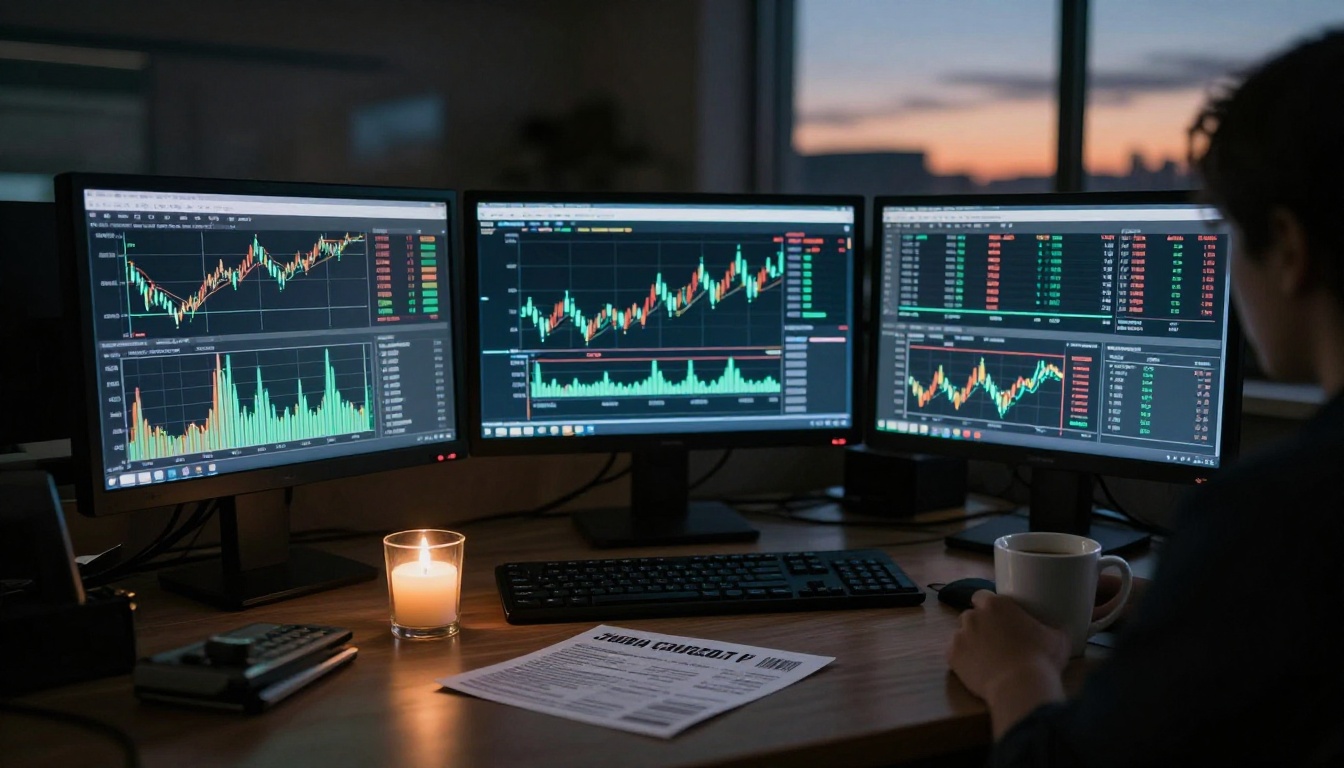
This article is general information, not financial, tax, or investment advice. Income claims and platform fees change. Talk with a licensed professional before making financial decisions based on anything you read here.
“4 stocks about to explode”: what The Traveling Trader’s macro pitch leaves out
Verdict: Half-true — works only if you do the unspoken work. The macro analysis is real and unusually good; the returns implied by the headline are not what most people who follow along will get.
A video titled “These 4 Stocks Are About to Explode‼️” sits at 125,415 views. It’s from The Traveling Trader, a channel run by a host who goes by “Z” and claims eight years of coverage plus a professional background in tech and finance. The headline promises explosive picks. The video mostly delivers a careful macro briefing — and a coupon. Is the analysis legit? Largely yes. Is the implied path to profit as clean as the thumbnail suggests? No.
What the video actually claims
The pitch is built around four sectors the host says are set up for “asymmetric profit opportunities” after a June-to-September pullback: power (Vistra, GE Vernova, Vertiv, and prior pick Bloom Energy), chips (Intel, Marvell, Broadcom, AMD), data centers (Nebius, IREN, CoreWeave, and Bitcoin-miners-turned-data-centers like Cipher and TeraWolf), and memory (Micron, plus the DRAM and EWY ETFs).
The framing is data-heavy. He cites a Goldman Sachs projection that AI data-center investment could reach $7 trillion by 2030, a forecast of four quadrillion annual AI tokens by 2030, and a $154 billion total addressable market for optical networking by 2028. He notes Bloom Energy’s first billion-dollar quarter, with revenue up 166%, and its addition to the S&P 500. He walks through CPI, PPI, the September 16 FOMC meeting, September options expiration, and a new Treasury buyback program. Then comes a genuinely useful section on bonds versus equities heading into 2027.
Two things recur. The first is Nancy Pelosi — the host repeatedly cites her purchases of Vistra and Bloom Energy as a bullish signal (“Nancy Pelosi does not miss”). The second is the ask: a paid community called the Traveling Trader Academy, a fundamental-analysis tool called Alphascope, a “Labor Day coupon” (30% off annual, 20% off monthly), and daily live sessions where the actual trade alerts — strikes, expirations, entries — live behind the paywall.
What the method actually requires
Start with what checks out, because a lot does. Bloom Energy really was added to the S&P 500; S&P Dow Jones Indices confirmed it and two other names would replace outgoing companies before trading on September 21, 2026, a move Bloomberg reported the same week. The bond argument is also grounded in something real. The host’s claim that the S&P 500’s equity risk premium has gone negative — that Treasuries now pay more than stocks are expected to return — matches independent reporting; Axios noted the premium to own stocks had all but disappeared by mid-2026. This is not a hype channel inventing numbers.
Here’s the gap. The video sells sector theses. The money is made or lost on execution — position sizing, strike selection, timing a “break and retest,” knowing when to cut a losing trade. All of that is explicitly behind the paywall. The host says so directly: the video tells you what he’s watching; the Discord tells you how he’s trading it, including whether he uses a leveraged ETF (SOXL, MUU) or options.
That distinction matters enormously, because leveraged and options-based trades are where retail money evaporates. A 2025 University of Florida study found retail traders lost money across every measured window on complex multi-leg options — averaging a 16.4% loss over three days. Reviews of 25 years of day-trading research put the share of retail day traders who lose money at 70% to 95%. One frequently cited Brazilian futures study tracked committed, persistent traders and found 97% of them lost money, with under half a percent out-earning a bank teller. The leveraged ETFs the host mentions carry their own quiet tax: daily rebalancing means a 3x fund like SOXL doesn’t return 3x the index over time — it decays in choppy markets, which is exactly the “sideways then break out” pattern he’s describing.
Is the Pelosi signal a real edge?
It’s the most seductive part of the video, and the most misleading. Congressional trades are real and public (the 2012 STOCK Act requires disclosure), and Pelosi’s long-run record is genuinely strong — reporting on the 2025 UnusualWhales data put her portfolio up about 20% for the year. But copying her is not the same as being her.
Disclosures lag the actual trade by up to 45 days, so by the time you see the filing the price has often already moved. And the outperformance is concentrated at the very top of Congress — leaders, not the rank and file, who tend to track or trail the index. You’re getting a stale signal from one exceptional trader and treating it as a system. That’s a story, not an edge.
Who actually wins this game
Three groups do well with content like this. The channel owner wins first — a free macro video is a funnel, and 125,000 views converts to paid Academy subscriptions and Alphascope affiliate signups whether or not any single pick works out. Experienced traders win second: someone who already understands options Greeks, can size a position, and has the discipline to cut losses can genuinely use sharp sector research as one input. And early, well-capitalized movers win third — the people who bought Bloom Energy or Vistra months before the S&P inclusion and the AI-power narrative went mainstream, not the ones buying after a stock is already up triple digits.
Notice who’s missing: the beginner who joins a Discord expecting to copy alerts. The host himself says it’s “obviously not meant to be a copy service.” That’s an honest disclaimer and a quiet admission — the value is in learning to trade, which takes years, not in the tips.
What you’d realistically earn
The video implies explosive, near-term gains. Reality for a new subscriber trading these setups is a wide, mostly-negative distribution. If 70–95% of retail day traders lose money and 80% quit within two years, the base-rate expectation for someone starting now is a net loss in year one, plus the subscription cost, plus trading fees and (if using options) bid-ask spreads.
Could you do better by simply buying the underlying investing theses — power, chips, memory — through low-cost ETFs and holding? Possibly. That’s a different activity from the trading the alerts describe, and it wouldn’t require a Discord. The host’s own bond math actually points there: if the equity risk premium is negative, a chunk of a portfolio in Treasuries paying 4.5–5.5% is a defensible, boring alternative to leveraged chip trades. The SEC’s investor alert on stock recommendations is worth reading before you pay for any tip service; the SEC also warns in a separate alert on investment newsletters that “publisher exclusion” lets these services operate without registering as investment advisers — meaning no fiduciary duty to you. (Non-U.S. readers: your regulator — the FCA in the U.K., ASIC in Australia, SEBI in India — draws similar lines around unlicensed tips.)
Who this is (and isn’t) for
This channel makes sense for an intermediate trader who already has capital they can afford to lose, understands options and leveraged ETFs, has 5–10 hours a week to watch charts and manage positions, and wants a second opinion on macro and sector rotation. For that person, a research subscription is a tool among many.
It does not make sense for someone with a few hundred dollars, no options experience, and an expectation that following alerts will replace a paycheck. If that’s you, the honest move is to learn on a paper-trading account first and treat the subscription fee as tuition, not investment capital.
What to remember
The Traveling Trader is more substance than most of what trends in this genre — the macro read on bonds and AI power demand is legitimate, and the Bloom Energy call was right. But the free video sells a narrative while the mechanics that actually determine profit or loss sit behind a paywall, and the base rates for the leveraged trades it hints at are brutal. Good analysis and a good outcome for you are not the same thing. For more on separating real income methods from funnels, see our looks at 16 stocks to buy now (July 2026) and 5 stocks I’m buying heavy right now (August 2026).
Sources
- S&P Dow Jones Indices. “Bloom Energy, Illumina, and Everpure Set to Join S&P 500.” 2026. https://press.spglobal.com/2026-09-04-Bloom-Energy,-Illumina,-and-Everpure-Set-to-Join-S-P-500-Others-to-Join-S-P-100,-S-P-MidCap-400,-and-S-P-SmallCap-600
- Bloomberg. “Bloom Energy, Illumina, Everpure to Join S&P 500 in September.” 2026. https://www.bloomberg.com/news/articles/2026-09-04/bloom-energy-illumina-everpure-to-join-s-p-500-in-september
- Axios. “The disappearing premium to own stocks.” 2026. https://www.axios.com/2026/05/27/stocks-bonds-yields-premium
- U.S. Securities and Exchange Commission. “Investor Alert: Beware of Stock Recommendations on Investment Research Websites.” https://www.sec.gov/resources-for-investors/investor-alerts-bulletins/ia_stockrecommendations
- U.S. Securities and Exchange Commission. “Investor Alert: Investment Newsletters Used as Tools for Fraud.” https://www.sec.gov/oiea/investor-alerts-bulletins/ia_newsletters.html
- The Paper Trading Journal. “80% of Options Traders Lose Money — Where the Real Edge Actually Is (2026 Data).” 2026. https://papertradingjournal.com/2026/03/31/options-trading-statistics/
- Yahoo Finance. “Trump vs. Pelosi: Who Made More Money in the Stock Market Last Year?” 2026. https://finance.yahoo.com/markets/stocks/articles/trump-vs-pelosi-made-more-120929567.html
- Video: These 4 Stocks Are About to Explode‼️ [September 2026]
- Channel: The Traveling Trader
- Views at review: 125,415
- Watch on YouTube: https://youtube.com/watch?v=chahOEXjQRE
- Views and other figures were accurate at the time of review and may have changed since publication.