Amazon FBA & KDP Half-true — works only if you do the unspoken work
AI kids’ books on Amazon KDP: the $5,838/month math the video skips
Verdict: Half-true — works only if you do the unspoken work. The production is genuinely easy; the earning is not.
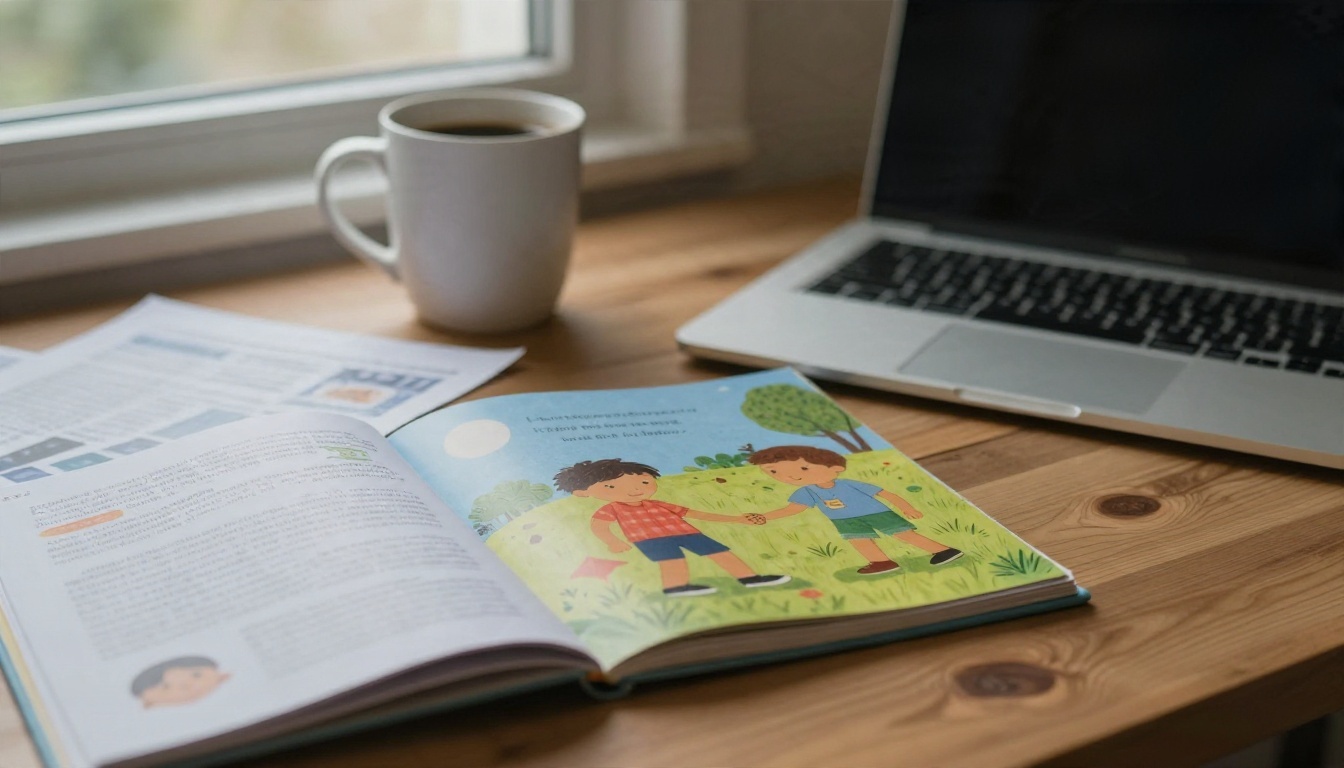
In “The Easiest Claude AI Side Hustle Everyone Is Overlooking,” YouTube creator Joshua Mayo shows himself reading a 24-page illustrated children’s book to his kids — a book he says he built entirely with Claude and ChatGPT, without drawing or writing a word. He then points a sales estimator at two other authors’ books and reports they’re earning roughly $5,838 and $3,761 per month. The video (101,663 views at the time of this review) walks through a nine-step pipeline from idea to a live Amazon listing. The workflow is real and you can follow it. Whether it pays what the thumbnail implies is a separate question.
What the video actually claims
The pitch has two layers. The first is a method: use Amazon’s own search autocomplete to find niches parents actually type (“kids book about apples”), check that competing books have a moderate number of reviews, then run a chain of prompts through Claude and ChatGPT to produce a story bible, a page-by-page manuscript, a locked character reference, and finished illustrated pages with the text baked in. Assemble the pages in Canva, build a wraparound cover using Amazon’s cover template calculator, and upload two PDFs to Kindle Direct Publishing. Mayo says the whole image-generation step takes about 30 minutes once your prompts are ready.
The second layer is the income framing. Using a third-party best-seller-rank estimator, Mayo attaches specific monthly numbers to books he didn’t make: $5,838 here, $3,761 there. His own demo niche estimate was more modest — about two copies a day, roughly $596 a month. The repeated instruction is to not stop at one book: “make your first book, and then go make four more,” because a catalog selling “24/7” is how the earnings supposedly scale.
There’s also a product. Twice in the video, Mayo points viewers to his paid “AI Kids Book Complete Publishing Kit” with a validated niche list and 1,000-plus prompts. That matters, and we’ll come back to it.
What the method actually requires
Start with the economics, because they’re knowable. Amazon’s own KDP printing-cost schedule charges a flat $3.60 per copy on Amazon.com for a premium-color paperback of 24 to 40 pages — the exact band a short picture book falls into. KDP pays a 60% royalty on the list price minus that printing cost. So a $12.99 picture book nets you about $4.19 a copy. To clear the $5,838/month figure in the video at that royalty, a single title needs to sell roughly 46 copies every single day, forever. Mayo’s own demo book, by his estimator, was closer to two.
That gap is the whole story. Those estimator numbers are modeled guesses from a best-seller rank, and rank is a snapshot — a book sitting at #55,992 today can be at #400,000 next week. More important, the books he profiled are survivors. He searched a niche, found titles that are already ranking, and read their numbers. You never see the thousands of AI picture books in the same niche selling zero.
Here’s the piece the “30 minutes” framing hides: ranking. Mayo himself says the sweet-spot competitor had about 80 reviews, and that a brand-new book can “realistically get past” that number. Getting 80 genuine reviews on a children’s book is not a prompt. It’s months of sales, review requests, and often paid Amazon ads to generate the early momentum that reviews depend on. Mayo also admits — to his credit — that he had “a hard time getting the cover approved” on both his books and that it “took a few tries.” KDP’s printer rejects covers with the AI artifacts that image models still produce. None of that is in the 30-minute clock.
| What the video shows | What it leaves out |
|---|---|
| ~30 min to generate pages | Weeks of niche research, cover rejections, proof copies |
| “Make four more” | Reviews and ranking that each book needs to sell at all |
| $5,838/month estimate | That number is a cherry-picked survivor, not a median |
| $4.19 royalty per $12.99 book | ~46 sales/day, every day, to hit the headline figure |
Two more things the video doesn’t mention. Amazon now caps AI-generated titles at three books per day per account and requires you to privately disclose AI use — which Mayo does cover — but enforcement has tightened, and undisclosed or low-effort AI books are being removed. And in the U.S., the Copyright Office ruled in its January 2025 report on AI copyrightability that purely AI-generated images, no matter how detailed the prompt, aren’t protected by copyright. Your text arrangement may be; the illustrations a competitor could copy are not.
Who actually wins this game
Think about who the winners in Mayo’s own demo really are. They’re not beginners who uploaded one book last Tuesday. The books earning real money are established listings with review counts, search-rank history, and usually a back catalog — the output of operators who’ve published dozens of titles and learned which niches convert. The economics reward volume and persistence, not a single lucky upload.
Self-publishing income follows a brutal power law. Industry data compiled across indie authors shows that roughly 90% of self-published books sell fewer than 100 copies in their lifetime, and about 75% of self-published authors earn under $1,000 a year. The authors clearing a living wage tend to have 25-plus titles. So the “go make four more” advice isn’t wrong — it’s just the quiet admission that no single book is the business. The catalog is the business, and building a catalog that ranks is a job.
What you’d realistically earn
Can a beginner replicate the $5,838 book? Almost certainly not on their first title, and probably not on their fifth.
A more honest range: expect $0 to a few dollars a month per book for the first several months while you have no reviews and no rank. A book that finds a real niche and accumulates reviews might settle into Mayo’s own demo figure — somewhere around $50 to $600 a month — after a year of consistent work and probably some ad spend. Stack five or ten of those and you have a side income that’s real but a long way from the thumbnail. The difference between the video’s number and this one isn’t dishonesty about the method. It’s the difference between showing a winner and showing the field.
Is the real product the course?
Worth sitting with the pattern here, because a U.S. regulator just drew a bright line through it. In April 2026, the FTC announced that Publishing.com agreed to pay $1.5 million to settle charges that it misled consumers about income from publishing AI-generated e-books and audiobooks. One of the specific claims the FTC flagged: a promise that buyers could copy a system students used to “make $1k to $3k a month in passive income.” The agency’s complaint said most customers never earned what the marketing promised.
That’s not an accusation against Mayo, whose free video teaches a genuine workflow and whose kit sells niche lists and prompts rather than a guaranteed-income program. But the structure — free video, income screenshots, paid kit to “skip the guesswork” — is the exact funnel the FTC has been dismantling across the AI side-hustle space. CNBC has tracked the broader sweep, including cases where “AI-powered” stores defrauded consumers of tens of millions on passive-income promises. When a video’s earnings examples are estimator readings on strangers’ books and the call to action is a paid product, treat the numbers as marketing, not a forecast. (That’s good practice with any creator, not just this one.)
Who this is (and isn’t) for
This makes sense if you have 5-10 hours a week for several months, a little patience for Canva and cover rejections, maybe $50-$200 to order proof copies and test a few ads, and the temperament to treat it as building a small catalog rather than cashing a lottery ticket. It fits people who’d enjoy the craft even at low pay. It does not fit anyone who needs money this quarter, who expects one book to be “passive,” or who’s counting on copyright protection for AI art they can’t actually claim. For more context on the platform’s history of hype cycles, see our look at the “once-in-a-lifetime” KDP opportunity pitch.
What to remember
The production side of this is honestly as easy as Mayo says — AI will build you a clean 24-page picture book in an afternoon. The earning side is where the pitch compresses a year of catalog-building, review-chasing, and market-fighting into a 30-minute montage and a survivor’s screenshot. Do the unspoken work and a modest income is reachable. Skip it and you’ll own a book nobody can find. For other Claude-based ideas with the same reality gap, compare our breakdown of Claude AI side hustles that claim a full-time income.
Sources
- Amazon KDP. “Paperback printing cost and royalty.” 2026. https://kdp.amazon.com/en_US/help/topic/G201834340
- FTC. “Publishing.com to Pay $1.5 Million for Misleading Consumers about How Much Income They Could Earn Using the Company’s Products and Services.” 2026. https://www.ftc.gov/news-events/news/press-releases/2026/04/publishingcom-pay-15-million-misleading-consumers-about-how-much-income-they-could-earn-using
- CNBC. “AI scammers on Amazon duped investors out of millions with ‘passive income’ scheme, FTC alleges.” 2025. https://www.cnbc.com/2025/03/18/ftc-amazon-ai-scammers-defrauded-users-with-passive-income-scheme.html
- U.S. Copyright Office. “Copyright and Artificial Intelligence (Part 2: Copyrightability).” 2025. https://www.copyright.gov/ai/
- Video: The Easiest Claude AI Side Hustle Everyone Is Overlooking
- Channel: Joshua Mayo
- Views at review: 101,663
- Watch on YouTube: https://youtube.com/watch?v=Sa_1q6cJHeQ
Views and figures above reflect the moment of review and may have changed since publication.